Mastering Sudoku: A Comprehensive Guide to 200 Easy Puzzles for KDP Publishing
Introduction to Sudoku
Sudoku is a popular number-placement puzzle that has captivated the minds of millions around the world. Originating from Japan, this deceptively simple game challenges players to fill a 9x9 grid with numbers so that each row, column, and 3x3 subgrid contains all the digits from 1 to 9. This article will guide you through the creation and publishing of a Sudoku puzzle book, specifically focusing on an easy-level collection designed for KDP (Kindle Direct Publishing).
Understanding the Basics of Sudoku
Before diving into the specifics of creating a Sudoku puzzle book, it's essential to understand the basic rules and structure of the game:
- Grid Layout: The Sudoku grid is divided into 81 cells, arranged in 9 rows and 9 columns.
- Subgrids: The grid is further divided into 9 smaller 3x3 subgrids, also known as regions or boxes.
- Filling the Grid: The goal is to fill the grid with the numbers 1 through 9, ensuring that each number appears only once in each row, column, and 3x3 subgrid.
Designing the Puzzle Collection
For a Sudoku puzzle book, especially one aimed at beginners, it's crucial to design puzzles that are both challenging and solvable. Here are some key considerations:
- Puzzle Difficulty: Start with easy-level puzzles to help new players build their skills. These puzzles typically have more pre-filled cells, making them easier to solve.
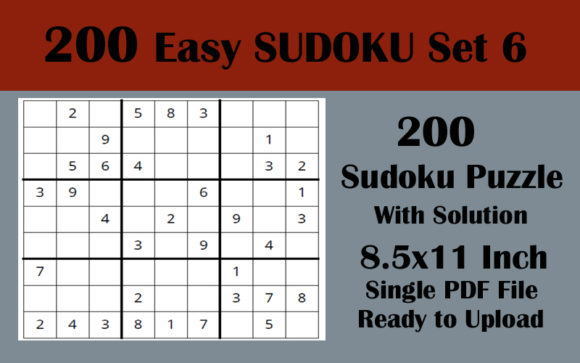
- Number of Puzzles: Aim for a substantial number of puzzles to provide value to the reader. In this case, we focus on 200 puzzles, which is a generous amount for a single book.
- Layout and Format: Each puzzle should be presented clearly and cleanly. For an 8.5x11 inch format, a single puzzle per page is ideal, allowing plenty of space for notes and solving.
Formatting for KDP
When preparing your Sudoku puzzle book for KDP, several formatting guidelines must be followed to ensure a professional and user-friendly final product:
- Trim Size: Use the specified trim size of 8.5 inches by 11 inches. This standard size is widely used and familiar to most readers.
- No Bleed: Since there is no bleed, make sure all content fits within the printable area of the page. Avoid placing any important elements too close to the edge.
- Page Count: The book should have 200 pages of puzzles, plus additional pages for solutions. This totals 250 pages, providing a comprehensive and engaging experience.
Enhancing Cognitive Skills
Solving Sudoku puzzles offers numerous cognitive benefits, including:
- Improved Concentration: Focusing on the puzzle helps improve concentration and attention to detail.
- Logical Thinking: Sudoku requires logical reasoning and problem-solving skills, which can be applied to various real-life situations.
- Stress Relief: Engaging in a puzzle can be a relaxing and enjoyable way to de-stress and unwind.
Use in Education and Daily Life
Sudoku puzzles are not just a pastime; they can also be integrated into educational settings and daily activities:
- Educational Tool: Teachers can use Sudoku to enhance students' mathematical and logical thinking skills.
- Family Activity: Solving Sudoku puzzles can be a fun and interactive family activity, promoting quality time and shared learning.
- Travel Companion: A Sudoku puzzle book is a perfect travel companion, providing entertainment during long journeys or waiting times.
Common Misunderstandings and Clarifications
There are a few common misunderstandings about Sudoku that are worth clarifying:
- Mathematical Skill: Contrary to popular belief, Sudoku does not require advanced mathematical skills. It is more about pattern recognition and logical reasoning.
- Uniqueness of Solutions: Each Sudoku puzzle should have a unique solution. Properly designed puzzles will not have multiple possible solutions.
- Difficulty Levels: The difficulty of a Sudoku puzzle is determined by the number of pre-filled cells and the complexity of the logic required to solve it. Easy puzzles are designed to be accessible to beginners.
Conclusion
Creating and publishing a Sudoku puzzle book, such as the 200 Easy Puzzles for KDP, is a rewarding endeavor that combines creativity, logical thinking, and practical publishing skills. By following the guidelines and best practices outlined in this article, you can produce a high-quality, engaging, and valuable resource for Sudoku enthusiasts and newcomers alike. Whether for personal enjoyment, educational use, or as a gift, a well-designed Sudoku puzzle book is a timeless and versatile addition to any library.