Stone and Minerals Journal: A Comprehensive Tool for Field Documentation and Analysis
The Stone and Minerals Journal is an essential resource for anyone involved in geology, mineralogy, or any field that requires detailed documentation of natural materials. This journal is designed to help professionals, educators, and enthusiasts systematically record and analyze their findings, ensuring that no detail is overlooked. Whether you are a seasoned geologist or a hobbyist, this journal can seamlessly integrate into your workflow, enhancing both the quality and consistency of your data.
Understanding the Stone and Minerals Journal
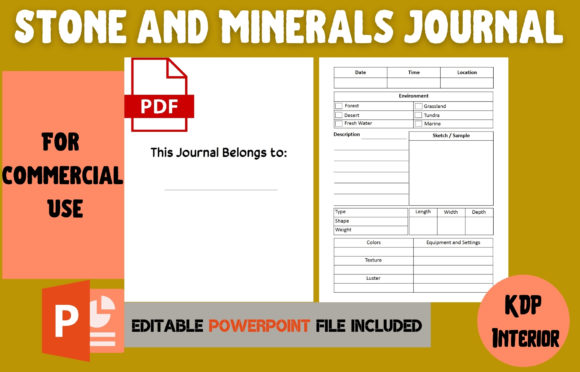
The Stone and Minerals Journal is a 120-page, 8.5×11 inch book, perfect for field use. It comes with a PowerPoint file for customization and a PDF file ready for print or digital upload. The journal is organized into several key sections, each designed to capture specific details about the samples you collect. These sections include:
- Date
- Time
- Location
- Environment (Forest, Desert, Fresh Water, Grassland, Tundra, Marine)
- Description
- Sketch Sample
- Type
- Shape
- Weight
- Colors
- Texture
- Luster
- Equipment and Settings
Preparation and Compatibility
Before heading out into the field, it's crucial to prepare your Stone and Minerals Journal and ensure it is compatible with your other tools and resources. Here are some practical tips:
- Customize the Journal: Use the provided PowerPoint file to add any specific fields or notes that are relevant to your project. This ensures that the journal is tailored to your needs.
- Gather Necessary Equipment: Make sure you have all the necessary tools such as a magnifying glass, scale, and camera. The "Equipment and Settings" section in the journal allows you to document these details, ensuring that your setup is consistent across different samples.
- Plan Your Route: Use the "Location" and "Environment" sections to plan your route and identify the types of environments you will be exploring. This helps in organizing your time and resources efficiently.
Using the Journal in the Field
Once in the field, the Stone and Minerals Journal becomes an indispensable tool for recording your observations. Here’s how you can use it effectively:
- Record Detailed Information: As you collect samples, use the "Date," "Time," and "Location" sections to log when and where each sample was collected. This information is crucial for later analysis and verification.
- Document Environmental Conditions: The "Environment" section allows you to note the specific type of environment (e.g., Forest, Desert) where the sample was found. This context is vital for understanding the sample's origin and characteristics.
- Create Sketches and Descriptions: Use the "Description" and "Sketch Sample" sections to visually and textually document the sample. This helps in creating a comprehensive record that can be referenced later.
- Measure and Record Physical Properties: The "Type," "Shape," "Weight," "Colors," "Texture," and "Luster" sections allow you to record the physical properties of the sample. This detailed information is essential for accurate identification and analysis.
Integration with Other Tools and Resources
The Stone and Minerals Journal can be integrated with various other tools and resources to enhance your workflow. Here are some ways to do this:
- Use with Digital Tools: After collecting and documenting your samples, you can scan or photograph the pages and store them digitally. This allows for easy sharing and collaboration with colleagues or students.
- Combine with Software: Integrate the journal with geological software or databases. The detailed information recorded in the journal can be used to input data into these systems, providing a more comprehensive and accessible dataset.
- Collaborate with Colleagues: Share the journal with team members or collaborators. The structured format makes it easy for others to understand and contribute to your findings.
Post-Field Analysis and Long-Term Use
After returning from the field, the Stone and Minerals Journal continues to be a valuable resource for analysis and long-term use. Here’s how you can make the most of it:
- Data Review and Analysis: Review the detailed information recorded in the journal to identify patterns, trends, and unique characteristics of the samples. This data can be used for further research, academic papers, or presentations.
- Long-Term Storage and Reference: Store the journal in a safe and accessible place. The durable 8.5×11 inch format and no-bleed design ensure that the journal remains in good condition for future reference.
- Continuous Improvement: Use the insights gained from the journal to refine your fieldwork and data collection methods. This continuous improvement process helps in maintaining high standards and achieving better results over time.
Conclusion
The Stone and Minerals Journal is a versatile and practical tool that fits seamlessly into the workflows of professionals, educators, and enthusiasts. By following the preparation, field use, and post-field analysis steps, you can maximize the journal's utility and ensure that your data is accurate, detailed, and well-organized. Whether you are conducting a research project, teaching a class, or pursuing a personal interest, the Stone and Minerals Journal is an invaluable asset that enhances your work and contributes to your success.